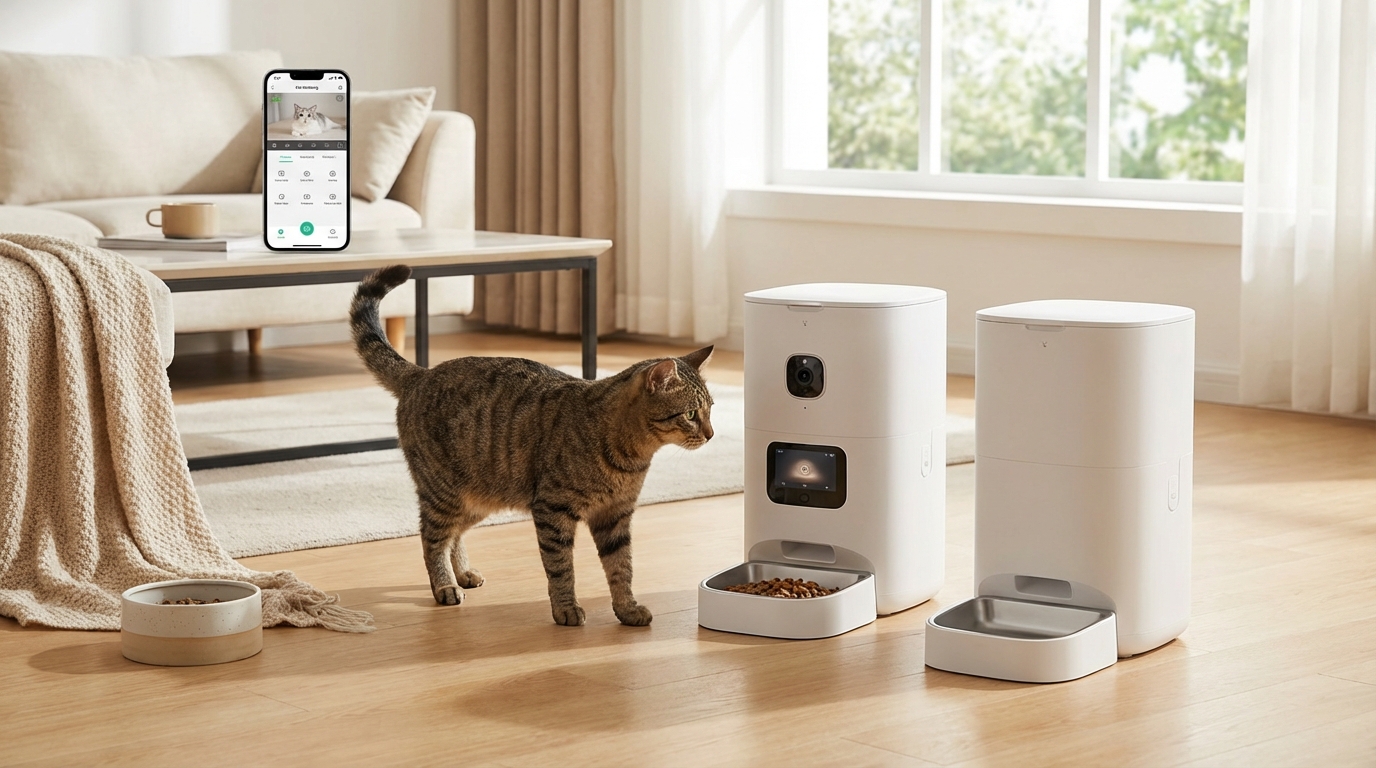
Imagine you are stuck at the office, a meeting is running late, and you know your feline companion is at home, pacing by an empty bowl. For many pet parents, this scenario triggers a wave of guilt and anxiety. The rise of automatic pet feeders has transformed this experience, moving from simple gravity bins to sophisticated smart devices that ensure your pet is fed on time, every time. PETSDA has emerged as a significant player in this space, offering solutions that cater to different needs and budgets. Today, we are looking at two of their heavy hitters: the PETSDA Automatic Cat Feeder 4L with 2K Camera and the more streamlined PETSDA 4L Automatic Cat Feeder.
While both devices share a core mission—dispensing food reliably—they represent two very different philosophies in pet care. One is a high-tech window into your pet's life, offering visual confirmation and remote interaction, while the other is a robust, 'set-it-and-forget-it' workhorse designed for simplicity and reliability. Choosing between them isn't just about the price tag; it's about how much connectivity you want in your daily routine and how much you value seeing your pet while you're away. In this deep dive, we will explore every facet of these two feeders to help you determine which one deserves a spot in your kitchen.
Whether you are a tech-savvy pet owner who wants to talk to your cat through a 2K lens or a minimalist who just wants a dependable schedule without the fuss of WiFi configurations, this comparison will break down the nuances of build quality, software performance, and long-term value. Both products boast impressive 5-star ratings, but the 'best' choice depends entirely on your lifestyle and your pet's specific needs.
Our Top Pick

PETSDA
PETSDA Automatic Cat Feeder 4L with 2K Camera
Best Overall:
If you want the ultimate peace of mind and enjoy interacting with your pet remotely, the Camera model is the clear winner. For $59.99, it offers a high-definition visual link to your home that the basic model simply cannot match. It is the superior choice for anxious pet parents or those who travel frequently.
| Feature | PETSDA 4L with 2K Camera | PETSDA 4L Basic Feeder |
|---|---|---|
| Price | $59.99 | $29.99 |
| Our Score | 9.8/10 | 9.8/10 |
| Camera Resolution | 2K HD (3MP) | None |
| WiFi Connectivity | Dual-band (2.4GHz & 5GHz) | None (Offline) |
| Max Meals Per Day | 15 Meals | 9 Meals |
| Portions Per Meal | 1-20 Portions | 1-15 Portions |
| Control Interface | Smartphone App | On-device LCD Screen |
| Audio | Two-way Audio | None |
| Capacity | 4L (approx. 15 cups) | 4L (approx. 15 cups) |
| Bowl Material | Stainless Steel | Stainless Steel |
| Power Source | AC Adapter + Battery Backup | AC Adapter + Battery Backup |
Connectivity and Remote Access: Smart vs. Offline
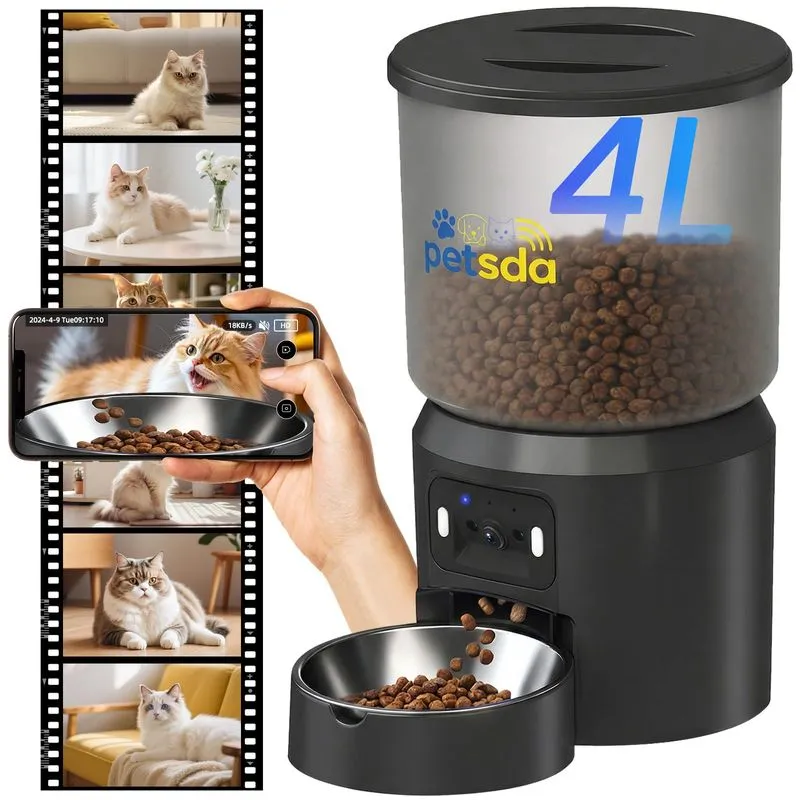
The most significant divide between these two units is how they communicate with you. The PETSDA Automatic Cat Feeder 4L with 2K Camera is a fully integrated smart home device. It features dual-band WiFi compatibility, which is a massive advantage in the current market. Many smart home devices are limited to 2.4GHz bands, which can be crowded and prone to interference. By supporting 5GHz, the PETSDA Camera model ensures a more stable connection and faster video streaming, which is critical when you are trying to check in on your pet from a cellular connection at work.
With the camera model, everything is handled via a smartphone app. You can adjust feeding times on the fly, trigger a manual 'snack' dispense from anywhere in the world, and receive notifications when a feeding has been successfully completed. This level of connectivity turns a chore into a data-driven part of your pet's health management. You can see exactly when they ate and how much, which is invaluable if you have a pet on a strict medical diet.
Conversely, the PETSDA 4L Automatic Cat Feeder is a 'dumb' device in the best way possible. It requires zero WiFi. For users who live in areas with spotty internet or those who are concerned about the security implications of having a camera in their home, the Basic model is a breath of fresh air. You program it using the physical buttons and the LCD screen located directly on the front of the unit. While you lose the ability to change the schedule while you're away, you gain a system that is immune to router crashes or firmware update glitches.
Why the 2K Camera Changes the Feeding Experience
When we look at the Camera model, the 3MP 2K sensor isn't just a gimmick—it's a high-fidelity monitoring tool. At 2K resolution, the image is sharp enough to see the individual kibble pieces in the bowl, allowing you to verify if your cat is actually eating or if they are just sniffing the food and walking away. The inclusion of infrared night vision means this monitoring doesn't stop when the lights go out. If your cat is a midnight snacker, you can check in without disturbing them.
The two-way audio is another game-changer. The camera model allows you to record a voice message that plays at mealtime, but it also lets you speak to your pet in real-time. If you see your cat scratching the sofa or looking lonely, you can chime in with a quick 'Hello' or a command. This interaction bridges the gap between a feeder and a companion tool. For many owners, the $30 premium for the camera model is justified solely by the reduction in 'separation anxiety' for the human, not just the pet.
Watch: PETSDA Automatic Cat Feeder 4L with 2K Camera
Scheduling Flexibility: Comparing the Logic Engines
When it comes to the granularity of feeding, the Camera model offers a slightly more robust scheduling engine. It allows for up to 15 meals per day. While most cats only need 2 to 4 feedings, the ability to spread 15 tiny meals throughout the day is a massive benefit for 'scarf and barf' cats—those who eat too quickly and then vomit. By breaking the daily intake into 15 micro-portions, you can force a slower eating pace that mimics natural hunting and foraging patterns.
The Basic model is no slouch, offering up to 9 customizable meals. For the vast majority of pet owners, 9 meals are more than enough. However, the programming interface is the differentiator here. On the Basic model, you have to cycle through menus on the small LCD screen. It is intuitive enough for anyone who has programmed a digital alarm clock, but it lacks the 'drag and drop' ease of the smartphone app found with the camera model.
Build Quality and Design: Shared Excellence
Physically, these two units share a very similar DNA. Both the Camera and Basic feeders feature a 4L (15 cup) hopper. This is a 'Goldilocks' size for cat owners—it's large enough to hold about two to three weeks' worth of food for an average cat, but small enough that the kibble doesn't go stale before the bottom of the bag is reached. Both units utilize a twist-lock lid which is essential for keeping curious paws out and keeping the 'crunch' in the kibble.
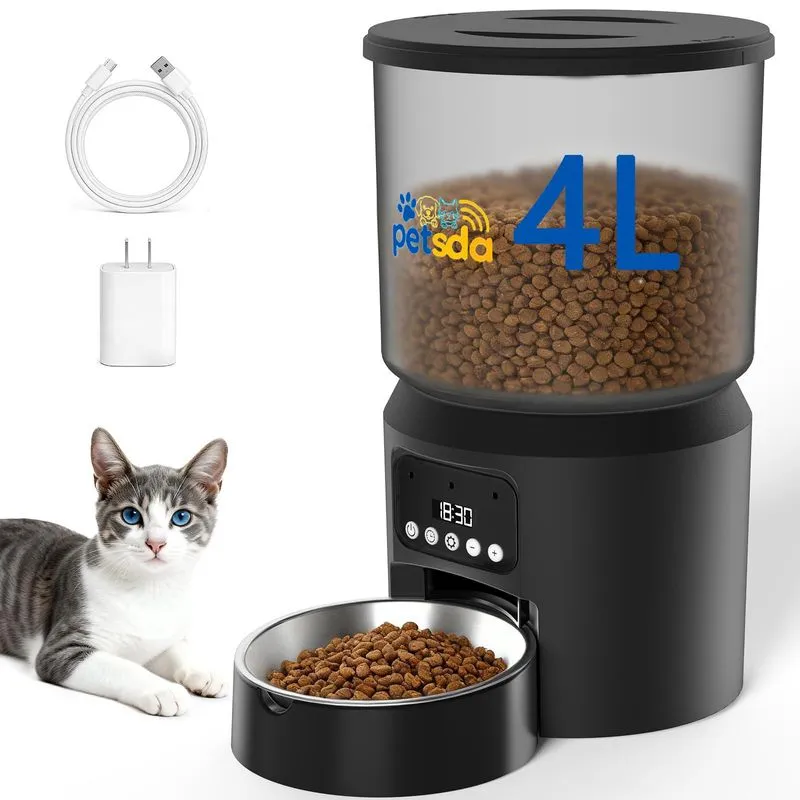
A standout feature for both is the use of a stainless steel bowl. Many cheaper automatic feeders use plastic bowls, which can develop microscopic scratches over time. These scratches harbor bacteria that lead to 'feline acne'—a painful skin condition for cats. PETSDA’s inclusion of high-quality stainless steel in both the $29 and $59 models shows a commitment to pet health that isn't always present in this price bracket. The bowls are easily removable and dishwasher safe, making maintenance a breeze.
The dimensions are identical at 11.41 x 6.7 x 12.79 inches, meaning they take up the same footprint in your kitchen. The Basic model mentions a 45-degree tilted feeding bowl design, which helps gravity move the food to the front of the bowl, preventing 'kibble dams' where food piles up at the back and the cat thinks the bowl is empty. While the Camera model doesn't explicitly highlight this in the same way, its internal dispensing mechanism is designed with similar anti-clogging technology to ensure a smooth flow of dry food.
Power Reliability and Backup Systems
Reliability is the number one concern for anyone buying an automatic feeder. If the power goes out, does your pet starve? Both PETSDA models address this with a dual power supply system. They primarily run on a 5V DC adapter that plugs into your wall. However, they both feature a battery compartment (typically for 3 C-cell batteries, though the Basic model explicitly mentions this while the Camera model notes 'battery backup').
In the event of a power outage, the feeders switch seamlessly to battery power. On the Basic model, the internal clock and memory chip keep the schedule running. Since there is no WiFi to maintain, the battery life in backup mode is exceptionally long. On the Camera model, the battery backup will still dispense the scheduled meals. However, to conserve power, the camera and WiFi functions are often disabled or limited during battery-only operation.
Watch: PETSDA 4L Automatic Cat Feeder
User Experience and Value for Money
The user experience is where your daily interaction with the device happens. The Camera model uses an app that provides a visual and snappy interface. You can see a calendar of feedings, check the logs to see if a meal was delayed, and even share access with family members. The Basic model offers a tactile experience with no accounts to create or passwords to remember. For people who are tired of 'everything having an app,' this simplicity is a major selling point.
At $59.99, the Camera model is an exceptional value, essentially giving you a high-quality pet camera and a 4L feeder for the price of one. At $29.99, the Basic model is an entry-level price for a premium-build product. It is rare to find a feeder at this price point that includes a stainless steel bowl and a 9-meal programmable timer. Both feeders represent the best of what the brand has to offer.
PETSDA Automatic Cat Feeder 4L with 2K Camera - Pros & Cons
thumb_up Pros
- check_circle Crystal Clear 2K Vision for detailed monitoring
- check_circle 15 meals a day for precise weight management
- check_circle Dual-Band WiFi (2.4GHz and 5GHz) support
- check_circle Interactive two-way audio
- check_circle Hygienic stainless steel bowl
thumb_down Cons
- cancel Requires stable internet for full features
- cancel Initial pairing can be finicky
- cancel Higher price point than basic models
PETSDA 4L Automatic Cat Feeder - Pros & Cons
thumb_up Pros
- check_circle Incredible value under $30
- check_circle Rock-solid reliability with no WiFi needed
- check_circle Simple LCD interface for manual adjustments
- check_circle Long-lasting battery backup
- check_circle Same high-quality stainless steel bowl
thumb_down Cons
- cancel No remote monitoring or app control
- cancel Must be physically present to change schedule
- cancel Lacks audio recording or two-way talk
Final Verdict: Which PETSDA Feeder Wins?
After a thorough comparison, it's clear that both the PETSDA Automatic Cat Feeder 4L with 2K Camera and the PETSDA 4L Automatic Cat Feeder are top-tier products. They both earn a 9.8/10 because they master the fundamentals of pet feeding: capacity, hygiene, and power redundancy.
Choose the Camera model if you travel frequently, need visual health monitoring, or want the convenience of app control. Choose the Basic model if you are on a budget, prefer a minimalist offline setup, or just need a dependable 'breakfast call' feeder while you sleep in. Your cat will thank you for the consistent, on-time meals regardless of which path you choose.
help Frequently Asked Questions
Can I use both feeders for a small dog? expand_more
Yes, both models are suitable for small to medium-sized dogs. The 4L capacity is plenty for a small breed, and the portion control allows you to set the larger amounts a dog might require compared to a cat.
What happens if my WiFi goes out with the Camera model? expand_more
If your WiFi goes out, the
How often do I need to clean the stainless steel bowls? expand_more
It is recommended to clean the stainless steel bowls at least once a week to prevent the buildup of oils from the dry food. Both models feature dishwasher-safe bowls for easy maintenance.
Can I use wet food in these PETSDA feeders? expand_more
No, both of these feeders are designed strictly for dry kibble. Using wet food or treats with sticky coatings can clog the internal dispensing mechanism and lead to spoilage.
"}